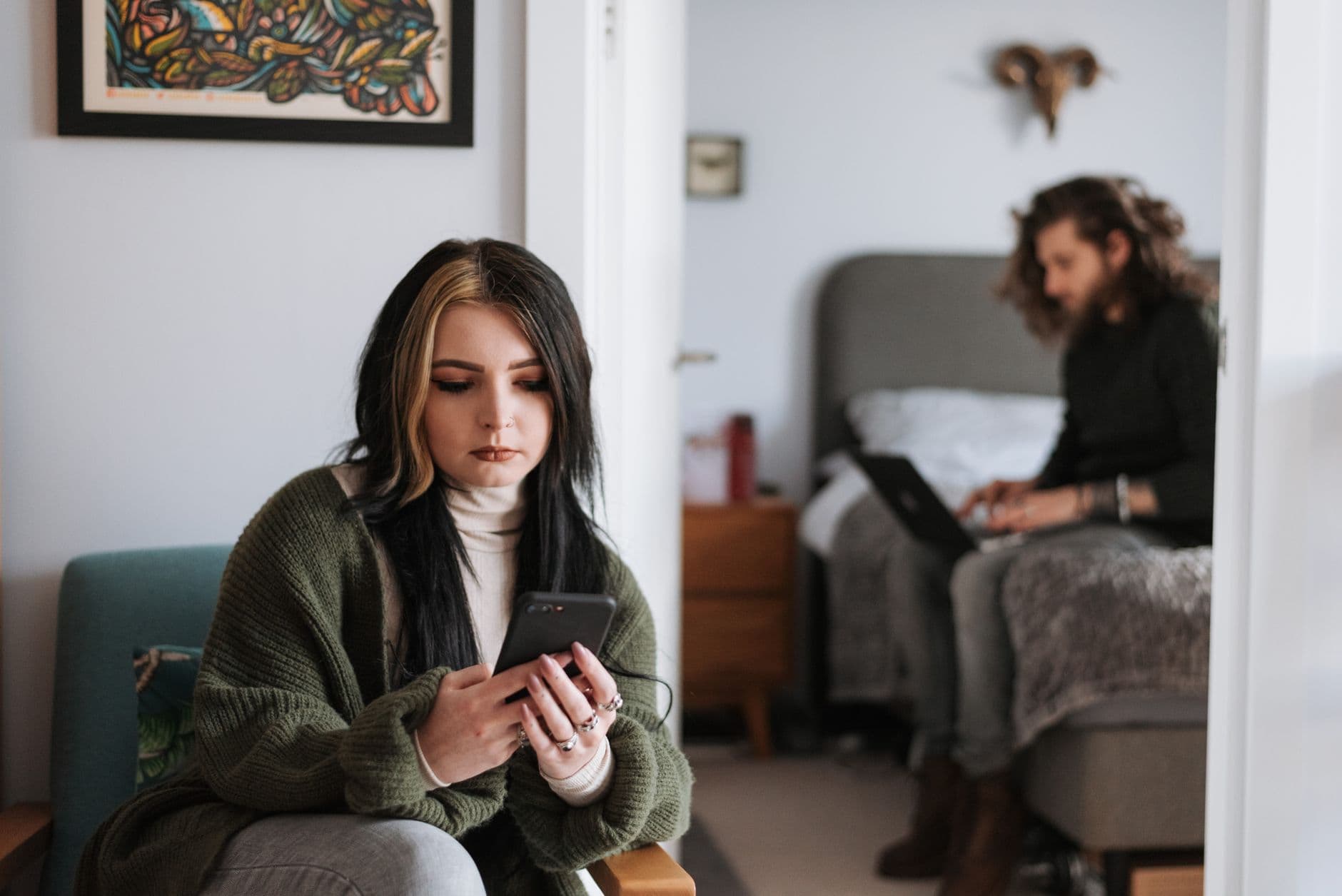
Suspecting that your partner may be unfaithful is one of the most unsettling experiences in a relationship. Your mind races, small things suddenly feel significant, and it becomes hard to tell the difference between a real warning sign and your own anxiety talking. This article walks through fifteen patterns that people commonly notice when something has shifted in a relationship. Read it with a clear head: no single item on this list proves anything, and there are almost always innocent explanations for any one behavior. What matters is the overall pattern, the change from how things used to be, and how the two of you communicate about it.
Before you read the list: context is everything
People go through stress, depression, work pressure, grief, and health problems that can produce almost every symptom described below without any betrayal involved. A partner who suddenly guards their phone might be planning a surprise, dealing with a difficult friend, or simply valuing privacy more than before. Treat these signs as prompts for an honest conversation, not as a verdict. If you find yourself building a case in secret, pause and ask what you actually want: certainty, reassurance, or a way to talk about how distant things have felt.
Behavioral changes
The first cluster of signs shows up in daily routines and habits. On their own these are weak signals, but a sudden bundle of them can be worth noticing.
- Unexplained schedule changes. New late nights at work, frequent "errands," or plans that shift at the last minute and never quite add up.
- A sharp increase in appearance or grooming. A renewed interest in fitness, clothes, or fragrance is healthy on its own, but paired with secrecy it sometimes registers as a change.
- Guarding their location. Being vague about where they have been, or reacting defensively to an ordinary "how was your day?"
- New expenses or hidden spending. Unfamiliar charges, a second account, or cash withdrawals that do not match your usual budget.
- Withdrawing from shared plans. Pulling back from family events, joint decisions, or future plans they were previously enthusiastic about.
Notice that each of these has a wholesome twin. A new gym habit is just a new gym habit for most people. What you are looking for is a departure from your partner's established baseline, several changes at once, and a reluctance to talk about them.
Emotional and relational signs
The second cluster is about the emotional texture of the relationship. These are often more telling than logistics, because they touch the connection itself.
- Emotional distance. Conversations feel shorter and shallower, and you sense them mentally somewhere else.
- Increased criticism or picking fights. Sometimes a person creates conflict to justify their own distance or absence.
- Defensiveness out of proportion. Simple questions trigger anger, counter-accusations, or "why don't you trust me?" before you have accused anyone of anything.
- Less physical and emotional intimacy — or, confusingly, a sudden surge of it that feels unfamiliar.
- Talking about a new person a lot, or suspiciously never at all. A name that keeps coming up, or a colleague they mention constantly and then abruptly stop mentioning.
Emotional signs are important because affairs are frequently emotional before anything else. But they overlap heavily with ordinary relationship fatigue, burnout, and mental-health struggles. Distance can mean "I am seeing someone else," and it can equally mean "I am exhausted and I do not know how to tell you." Only a conversation can tell those apart.
Phone and digital signs
Because so much of modern life happens on a phone, the device often becomes the focus of suspicion. Approach this cluster with particular care, both because it is easy to misread and because how you respond to it has legal and ethical weight, which we cover below.
- Suddenly protective of the phone. Taking it everywhere, turning it face-down, or changing a passcode they used to share.
- Notifications hidden or silenced. Message previews switched off, or the phone kept on silent in a way it never was before.
- New or secretive apps. Unfamiliar messaging apps, or apps that seem designed to keep conversations out of view. If this is where your worry sits, our overview of the hidden apps some people use to hide messages explains the categories and why their presence is not proof of anything.
- Deleting messages and call history. A conversation log that is always mysteriously empty can feel pointed.
- Quick screen-switching. Closing the screen the moment you walk into the room.
Every one of these has legitimate explanations: privacy preferences, a surprise, work confidentiality, or simply tidy habits. Digital signs feel like hard evidence because they are concrete, but they are among the easiest to misinterpret and the most fraught to investigate.
Why no single sign is proof
Human beings are pattern-seeking. Once you are worried, your attention narrows and you start collecting confirmations while discounting the ordinary explanations. This is a well-known feature of anxiety, and it can manufacture a convincing story out of coincidences. A partner who is more distant, more private with their phone, and working later might be having an affair, or might be quietly struggling with something they have not found the words for. The honest position is uncertainty, and uncertainty is uncomfortable, but pretending you have proof when you have only a feeling usually makes things worse.
Ask yourself a few grounding questions. Has this genuinely changed, or am I noticing things that were always there? Am I looking for the truth, or for a reason to end something I am already unhappy in? Would I be comfortable if my partner knew I was watching this closely? Those questions keep you honest with yourself, which is the first step to being honest with them.
The healthy path: an honest conversation
The most reliable way to resolve suspicion is also the hardest: talk about it directly. Choose a calm, private moment. Lead with how you feel and what you have noticed rather than with accusations — "I have felt distant from you lately and it is worrying me" invites a very different response than "who is she?" Be specific about behaviors, not motives, and then listen. You may hear something painful, or you may hear an explanation that dissolves the worry entirely. Either way you will know more than surveillance would ever tell you.
If conversations keep collapsing into conflict, a couples counselor or therapist can create a structure where both people feel safe enough to be honest. Many relationships that survive a period of suspicion do so because the crisis forced a long-overdue conversation about needs that had gone unspoken.
Lawful boundaries around checking a phone
It is tempting to reach for someone's phone when trust has frayed. Be careful. Secretly accessing another adult's device, accounts, or messages without their consent can break wiretapping, privacy, and computer-access laws in many places, and it can seriously damage your own legal position if the relationship ends in a dispute. Monitoring tools like TruSpyX™ are built for lawful uses such as parents overseeing their own minor children or transparent, consent-based arrangements between adults — not for secretly spying on a partner. If you are considering any kind of monitoring, read our plain-language guide to monitoring a partner's phone legally and our overview of where phone monitoring is and is not legal first. The safe and healthy version of transparency is mutual and agreed, such as sharing locations or accounts openly, not covert.
If suspicion has reached the point where you are thinking about surveillance, that itself is a signal that the relationship needs a direct, honest reckoning — with each other, and possibly with a professional. Trust, once questioned, is rebuilt through openness, not through secret checking that would corrode it further even if it revealed nothing.
Worry is exhausting, and clarity is worth pursuing. But the clearest, safest, and most respectful route runs through conversation, not through someone else's private phone. If your interest in monitoring is a legitimate and lawful one — your own child's safety, or a transparent agreement between adults — you can learn how TruSpyX™ approaches it responsibly on our features page.